How to Read Music on Treble Strings
If you want to learn how to read music for guitar, you have a few options as explained in this guide.
In this guide, you will larn the basics of how to read Standard Notation. Standard Notation is the formal manner of writing music for many dissimilar instruments.
In almost all sheet music books you can buy for guitar, Standard Annotation volition exist used. Many guitar books will also include Guitar TAB alongside Standard Notation.
Note:this is a long guide to cover everything you lot would desire to know when learning how to read standard note for guitar.
I recommend bookmarking/favoriting this page and then you lot tin refer back to it as you larn to read music.
By the terminate of this guide, you volition know plenty to read sheet music for guitar and be able to slowly work out how to play information technology.
It volition take practice to be able to read sheet music for guitar, just this guide volition explain everything y'all need to know to become started.
How to Read the Staff
The starting time thing we need to empathise when reading canvass music for guitar is the staff.
Staff and Bar Lines
The staff is made out of five horizontal lines:

Notes are placed on or in-betwixt these lines to represent notes on the guitar.
The staff is split up into bars (or measures) using vertical lines chosen bar lines:

The position of these bar lines depends on how many notes are in the bar and the time signature (covered later). Every bar lasts the same length of fourth dimension unless a time signature tells you lot otherwise.
Clef Symbols
At the far left of the staff, a symbol chosen a clef is used to tell you what blazon of staff this volition be.
There are 3 types of clef symbols yous may see used in music every bit shown below: 1000 Clef (Treble), F Clef (Bass), and C Clef (moveable).
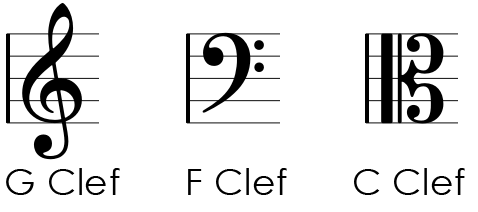
Guitar sheet music is typically written with a Treble clef and bass sheet music is typically written with a Bass clef.
The end of the little curve is positioned shut to the 2d line, which means that this line represents the notation Thousand.
The C clef is used with other instruments, so we won't wait into it in this guide.
Staff Note Positions
With the Treble clef in position, we can now await at the notation positions on the staff.
A note can be placed on each of the five lines to represent a note as shown beneath:
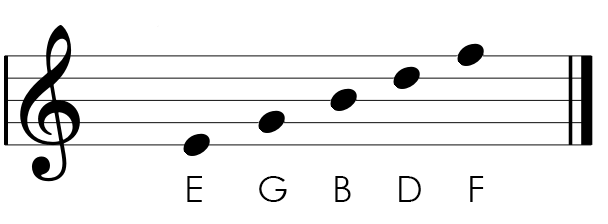
The bottom line is Eastward, the second line is Chiliad, the third line is B, the fourth line is D, and the fifth line is F.
Nosotros tin can too identify notes in-betwixt the lines which are called spaces.

The infinite beneath the lesser line is D, the lesser space is F, the 2nd space is A, the tertiary space is C, the fourth space is Due east, and the space above the top line is G.
Hither are all of the notes in the staff when we combine the lines and spaces:

If yous count all of those dots, you lot stop upward with 11 notes.
Obviously we tin can play a lot more than eleven notes on a guitar. To solve this problem, we utilize different symbols to extend the staff to embrace the unabridged range of the fretboard.
Ledger lines
The lowest note shown above is D beneath the bottom line. What if we wanted to play a note lower than this?
Ane style we can do it is withledger lines. A ledger line is a short line you add together to the staff to extend information technology above or below the 5 lines.
Here are a few examples of ledger lines below the staff:
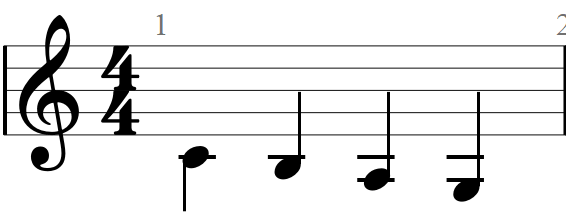
The very start notation is on a ledger line below the staff. We know that the lowest space beneath the staff is D, and then the adjacent note down from D is C.
The space below this ledger line is B, followed by A on the 2d ledger line.
Here are a few examples of ledger lines above the staff:
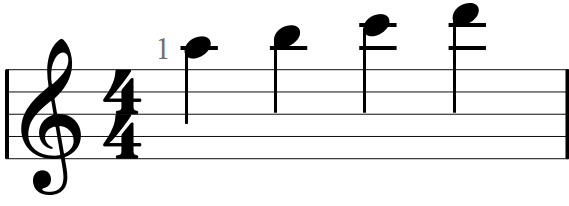
The very first note is on a ledger line above the staff. We know that the highest infinite above the staff is One thousand, so the next note upwardly from G is A.
The infinite above this ledger line is B, followed past C on the second ledger line.
8va and 8vb
We can extend ledger lines equally far as we have space, but information technology can become hard to read when a lot of ledger lines are used.
If we demand to play very low or high notes on the guitar, instead of using ledger lines, nosotros tin utilise a symbol to 'shift' the staff up or down an octave.
In the below example, you lot tin can see that at that place is '8va' and a dotted line written to a higher place the staff.

This means that every note beneath the dotted line should be played an octave higher than what is written.
The 2nd bar shows the exact same 4 notes without 8va written. Yous can come across that using 8va makes these notes easier to read.
8va means 'an octave in a higher place' and 8vb means 'an octave below'.
This means nosotros accept two ways of writing low or loftier notes. Nosotros tin can utilize ledger lines or 8va/8vb.
If a note is really high upwards the fretboard, you might meet 15ma used. This is the symbol for ii octaves to a higher place.

Hither are the aforementioned iv notes as earlier with 15ma. These are the same notes, but they're written lower down on the staff. This is very handy when reading music really high up on the fretboard.
What almost actually low notes? While a standard tuned guitar won't need anything farther than 8vb to show all of the notes, some guitarists tune down (eg: drop tunings or extended range guitars).
Instead of using a dissimilar symbol, you're more likely to see the bass clef used. Notes on the bass clef are positioned differently than the Treble clef, and then keep this in mind if you see the bass clef.
Notation: if this information feels overwhelming, don't stress. Go along reading to learn how to lucifer the notes on the staff to notes on the guitar and focus your exercise in that location.
Afterwards on, when you commencement seeing ledger lines or 8va/8vb symbols in music, yous tin come dorsum and refresh your noesis.
Finding Notes on the Guitar
Now that you know how to read the basic staff and the annotation positions on the staff, allow'southward look at how to find those notes on the guitar fretboard.
Let's first by finding the open up cord notes on the staff.
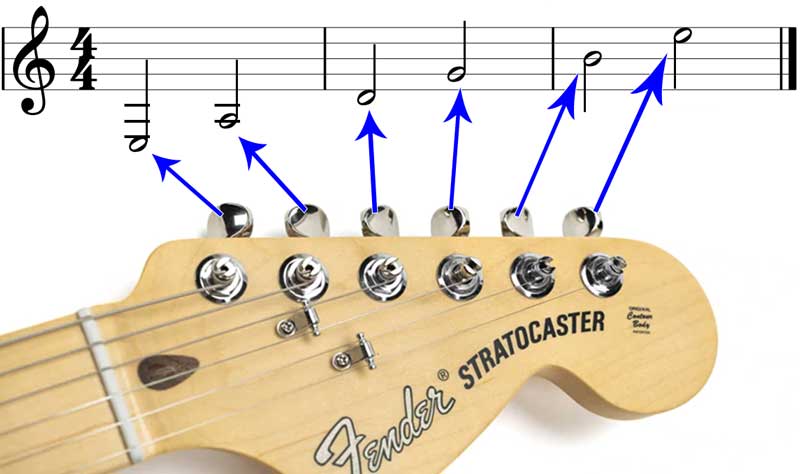
As you can see in the to a higher place diagram, the open up string notes cover a wide range of the staff.
Ledger lines are used for the lower strings East and A, so you're likely to see a lot of 8vb used when playing low riffs.
The loftier E string matches the top infinite on the staff. This means that every notation on the Eastward string is in a higher place the staff, so you can expect to run into a lot of ledger lines or 8va for high licks and solos.
Here is an example of the C Major scale played from the depression open up Due east string all the way to the high E string:
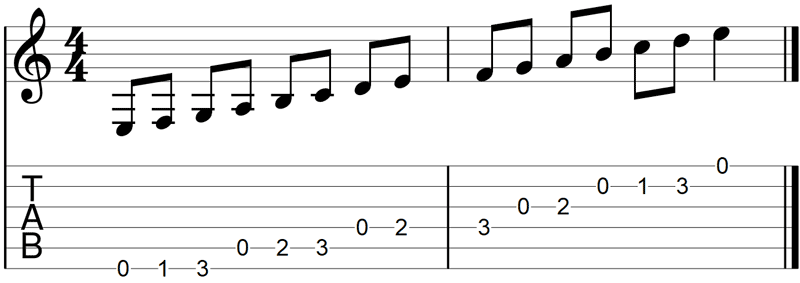
I've included Guitar TAB below the Standard Notation so you tin use information technology to help you learn the note positions. But remember that everything lines up vertically, and then each Guitar TAB number matches the note above it.
If yous don't already know the notes on the fretboard, read this Guide to Memorizing the Fretboard. Memorizing the notes on the fretboard volition speed up your learning and help you read music faster.
Guitar sheet music and other instruments
I important matter to understand about canvas music for guitar is that the notes on the staff and the notes you lot hear on your guitar aren't exactly the same.
Sheet music for guitar is written i octave higher than it sounds.
What this ways is that if a pianoforte plays the note middle C and you lot play what looks like middle C on your guitar, you will find that your guitar sounds an octave lower than the piano.
The technical reason for this is because the guitar is a transposing instrument. The note you hear sounds an octave lower than written.
This doesn't touch the way you read music, simply if you lot share canvas music with musicians who play other instruments, you volition notice a deviation in what they play with your sheet music.
Sharps and Flats
Now that y'all have read all of the notes on the staff, it's time to wait at the in-between notes.
For example, here are the notes E, F, and G (open, start, and third frets) on the high E string:
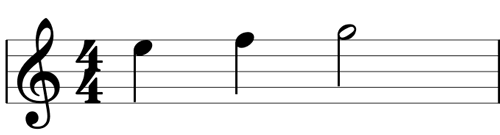
What if we wanted to play the 2d fret?
To show these in-betwixt notes on the staff, we use precipitous and flat symbols.
Asharp symbol (looks similar a #) means to play the annotation one semitone higher. One semitone on guitar is i fret distance.
Then to play the 2d fret on the high E string, we use a precipitous symbol to the left of the note F to say we want to play a note ane semitone higher than F:

This note is called 'F sharp'. It is ane semitone higher than F.
Alternatively, we can use aflat symbol (looks like a b), which means to play the note one semitone lower.
And so instead of calling the second fret annotation F sharp, nosotros can call it G flat because it is one semitone lower than G.

Whenever you encounter a note with a flat symbol next to information technology, but think to yourself that you need to shift down one fret to play it.
You may notice that the note G suddenly shows a new symbol, this is chosen a natural symbol and is explained subsequently.
Here are some other examples of precipitous and apartment notes.
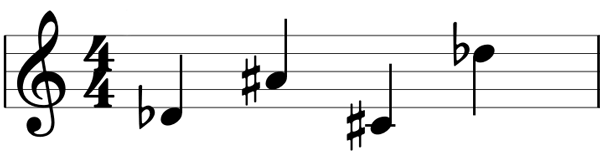
Practice figuring out what these notes are called, so effort to find them on the fretboard.
Repeating Sharp and Flat Notes
What happens if you desire to play four C# (C sharp) notes in a row?
In Standard Annotation, you don't write the sharp symbol 4 times in a row. Instead, you write the symbol the get-go fourth dimension and information technology is assumed that the same note is played on the next three repetitions.

In the above instance, it may look like you need to play C# followed by iii C notes, merely information technology is really four C# notes. The sharp symbol continues until the end of the bar.
If you want to continue to play C# in the next bar, you volition see the sharp symbol appear the commencement time C# is played over again in the second bar.

In the above example, you can see that there are eight C# notes. Iv in the commencement bar and iv in the second bar. The precipitous symbol is merely shown in one case per bar at the first C#. The 2nd time you see a C note, information technology means to keep to play it as C#.
Everything covered in a higher place also applies to flat notes. If you desire to repeat a flat note, y'all don't demand to write the symbol once again if it is in the aforementioned bar.
Natural Symbols
What happens if yous play an F#, then you want to play F later it in the same bar?
To do this, we use anatural symbol as shown below:
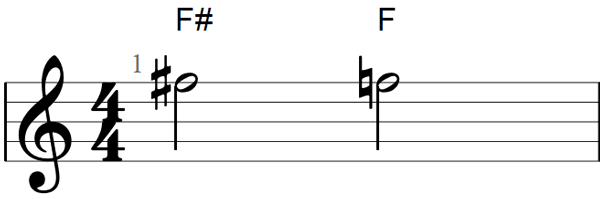
The natural symbol tells us to abolish the precipitous or apartment symbol that was used before it and play the annotation natural (eg: play F instead of F#).
Natural is simply a way to say 'play the normal notation without the sharp or flat'.
To empathise how these piece of work, let's play the notes F F# F# F F F# F F:
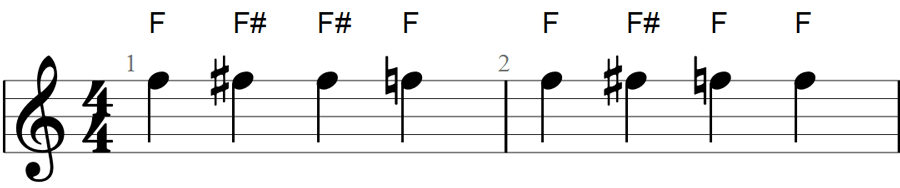
If the above example looks confusing, just take it one annotation at a time from left to right. If there is no symbol next to the notation, take a look at the previous annotation to effigy out what information technology should be.
Y'all can see from the above example that a natural symbol is but used when changing from F# back to F.
The natural symbol isn't used in the very first note of the bar because the bar doesn't showtime with a sharp symbol (something that can happen as explained afterward during the section on fundamental signatures).
How to Read Rhythm Notation
So far, you take learned how to read the notes on the staff and how to find those notes on the fretboard.
At present, let's await at how long to play each annotation for.
Rhythm annotation is the symbols used to tell us how long to play each note. Rhythm annotation is so important that even modern Guitar TAB uses it.
The shape of the dots on the staff stand for different lengths of notes.
Note Symbols
The first annotation symbol is a widened circle:
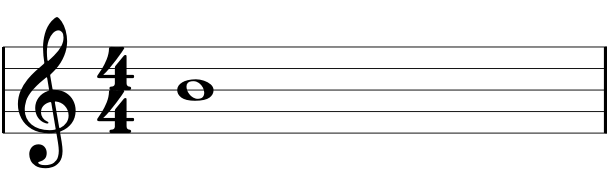
This notation is called awhole note (American terminology) or semibreve (British terminology) and lasts for four beats.
Note:there are ii names for every type of note – an American name and a British name. Information technology doesn't matter where you alive, I recommend learning both names so you can empathise all musicians.
If in that location are four beats in a bar (known as iv/4 time), a whole note volition last the entire bar.
If you encounter a notation that looks like a whole note but has a stalk (vertical line) attached to it, this is called aone-half notation (American) or minim (British).

A half note lasts for two beats. The stem tin can either point upwards or down to brand the sheet music look easier to read (eg: loftier notes will take the stem point downwardly and low notes will have the stalk point upwardly).
If a half note's circle is filled in black, this is aquarter note(American) or crotchet(British) and lasts for 1 beat.

Nigh of the time when you lot count 1 – two – 3 – 4 in your head to the vanquish of the music, yous are counting in quarter notes.
If you see a blackness note with a stem and a tail, this is aneighth note(American) orquaver (British) and lasts for half a crush.
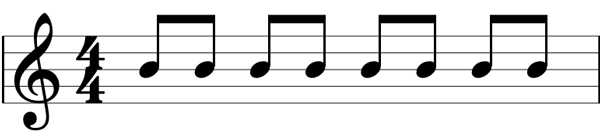
As you tin can see above, an eighth annotation can either take a tail at the elevation of the stem, or it can be connected to some other eighth note with a beam (it tin be connected to all of the below notes likewise).
A black annotation with ii tails or two connecting beams is asixteenth note(American) orsemiquaver(British) and lasts for a quarter of a beat.

You lot can encounter that each type of annotation is half the length of the previous note symbol.
We tin can keep adding tails or beams to the notes to continue to halve the note length.
And then if you lot run into a note with 3 tails or beams, information technology is athirty-2d noteordemisemiquaverand lasts for an 8th of a crush.

This can continue to threescore-fourth notes and further, merely you are unlikely to see anything past 30-second notes.
Remainder Symbols
All of the in a higher place symbols are used to tell yous how long to play a annotation. Simply what about when you don't desire to play a note?
Rest symbols are used to tell you how long to play nix but silence.
For each of the above notation symbols, there is a matching rest symbol.
Here is awhole rest symbol which lasts for four beats (aforementioned equally a whole note):

Here is ahalf rest symbol which lasts for two beats:
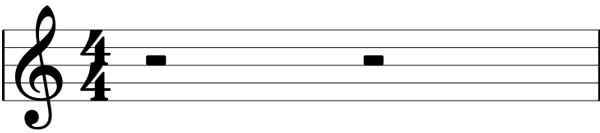
When comparing the whole and half rest symbols, look at how the blocks connect to the lines. A whole residue symbol touches the 2d line and the half rest symbol sits on the third line.
Hither is aquarter rest symbol which lasts for 1 beat:

Hither is aneighth rest symbol which lasts for half a beat:

Hither is a sixteenth rest symbol which lasts for a quarter of a beat out:

Equally you lot can see, a sixteenth rest symbol doubles up the eighth remainder symbol which is similar to how a sixteenth notation uses ii beams instead of one.
You tin probably guess what athirty-2nd residue looks like if you follow the higher up example:

This same pattern continues, but you're unlikely to run into shorter rests than this.
Any combination of the in a higher place symbols tin can exist used in a bar equally long as the total length of rests and notes adds up to the right number of beats (explained later).
Dotted Notes
You lot might notice that each new symbol halves the length of the previous 1. But what if nosotros want to play a iii-beat out note or a one-and-a-one-half beat note?
In that location'southward a simple fashion to do this and information technology is chosen a dotted note:
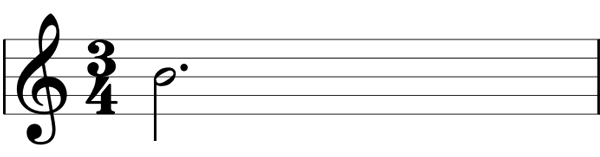
By placing a dot to the side of a note or balance symbol, it means that symbol lasts for i-and-a-half what it would commonly last for.
To figure out the length of the dotted note, you lot multiply the original annotation length past 1.5.
And so if the symbol is a one beat annotation, a dot next to it means to play it for ane-and-a-half beats (ane x 1.5 = 1.5).
If a dot is next to a one-half note (two beats), information technology now lasts for three beats (2 10 1.5 = 3). You tin can run into a iii-beat note in the above example.
Whatever annotation or rest symbol tin can take a dot next to it to change the duration.
Tuplets
What happens if you have a four-trounce bar but yous desire to play three notes evenly throughout the bar?
ATuplet is when you divide the beat into irregular values that don't line up with normal note lengths.
Tuplets can quickly get complicated, so I'll go along the examples basic.
The below case shows how you tin play iii notes spread over four beats:
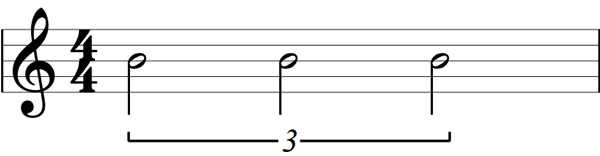
Unremarkably, each of the to a higher place notes lasts for two beats. That means there would be six beats in the bar – which doesn't work when there are only four beats in a bar.
The subclass and 'three' nether the notes tells united states to play these as tuplets.
When in that location is a '3' in the bracket, this is called atriplet.A triplet is one of many different types of tuplets and the most mutual you will run into.
An piece of cake way of thinking nigh this is that the 3 tells us to play these iii notes in the time of 2 notes. Two of these notes adds up to four beats, so that'due south why this bar works.
Hither is another example of triplets using eighth notes:

Normally, three of these notes would add upwardly to one-and-a-one-half beats. If you count upwardly all of the eighth notes, you'll notice there are too many to fit in the bar.
Just when eighth notes are played as triplets, they are played in the fourth dimension of two 8th notes (one shell).
Tuplets can get really disruptive when they are grouped in numbers higher than 3, so for at present, just exist enlightened that they can exist.
How to Read Chords
Now that you know how to read notes, rests, and the rest of the staff, you lot can start learning music!
Chords are easy to read in standard note as y'all merely need to recall ane thing: when notes are stacked on top of each other, they are played at the same time.
A chord is simply a agglomeration of notes stacked on top of each other as shown beneath:

Information technology volition have some time for yous to get used to reading chords and it will be slow at first as you will need to effigy out each individual note.
Over time, you volition learn to identify chords instantly without having to stop and effigy out each individual note.
Here are some mutual chords in standard notation:
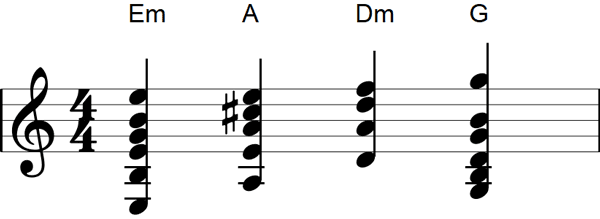
A limitation of standard annotation is that information technology doesn't tell you where to play these notes (it's rare to see note to say which string to play the notes on). So you need to figure out whether these chords should be played open or every bit barre chords.
In sheet music, chord diagrams are usually placed on the showtime folio for a song so you know what chords volition be used.
In the below example, you lot can see that chord diagrams for the vocal are shown first (highlighted in yellowish), so the chord names are placed above the staff to help you quickly identify each chord.
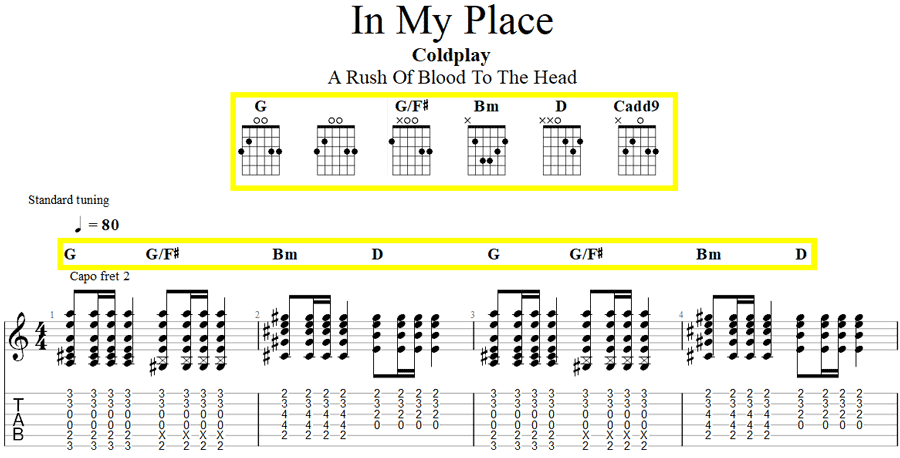
I highly recommend learning to read chord diagrams so you have two different ways yous can identify chord shapes. Check out this Guide on How to Read Chord Diagrams.
How to Read Fourth dimension Signatures
It's of import to know how many beats are in a bar. Some songs follow the typical 4-beat design (eg: 1 2 iii 4 i two 3 iv), others use a 3-crush pattern (eg: one 2 3 ane ii 3), while others are a chip more than complicated.
You tin tell how many beats are in a bar by reading thetime signatures at the starting time of the staff besides as any time the beats modify.
Time signatures are also known asmeter signatures ormeasure signatures.

In the above example, you tin can see that the vocal starts in 4/4 time (say: four four fourth dimension).
What this ways is that at that place are four beats in a bar (the acme number) and each beat lasts for a quarter (the bottom number).
Have a look at the below case and what the time signature means:
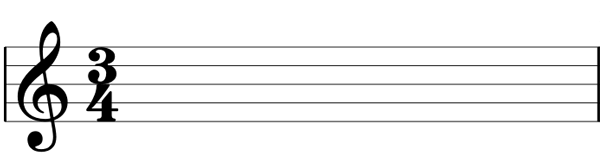
This time signature is telling united states of america that in that location are three beats in a bar (superlative number) and each beat lasts for a quarter (bottom number). We telephone call this iii/4 time (say: 3 four time).
The bottom number isn't e'er four, but it is the virtually common you will see. Here is an example of vi/8 time:

This time signature means in that location are six beats in a bar and each beat lasts for an 8th.
iii/iv vs half-dozen/8 fourth dimension
If you compare 3/4 time and 6/viii fourth dimension, you might notice that equally fractions they are exactly the same.
The difference between 3/4 time and 6/8 fourth dimension is how it feels and how you count.
In 3/iv time, we count 'ane two 3 1 two 3'. In half dozen/8 time, we count 'ane 2 three iv 5 6 1 two 3 4 5 6'.
If the tempo is the aforementioned for both examples, we would be counting the beats in 6/8 time twice every bit fast as we count the beats in 3/4.
They may look the same, but the mode we remember about and feel the music changes.
A song can change how many beats are used in a bar at any time. Some styles of music (eg: progressive metal) are well known for using a lot of fourth dimension changes.
Hither is an extreme example from Dream Theater'southward The Dance of Eternity:
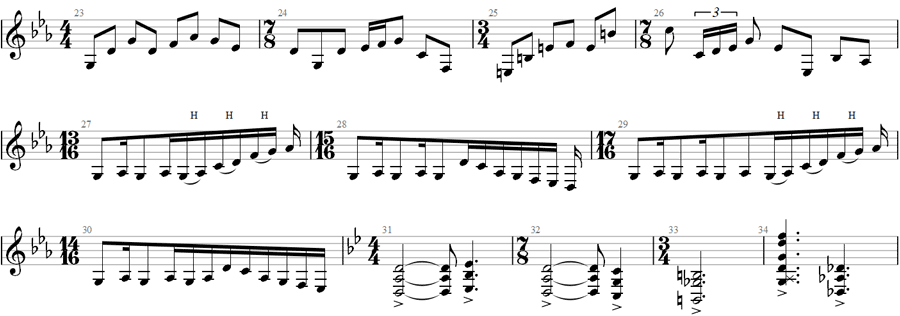
You lot can see that almost every bar changes time signatures. The example starts in iv/4 fourth dimension earlier changing to vii/8 time.
A 7/8 time signature means there are seven beats per bar and each beat lasts for an eighth. Think of information technology every bit seven eighth notes in a row.
Remember that this is an farthermost example, so you're unlikely to run across time signatures like 13/16 or 17/16.
Odd time signatures (with an odd number on top) aren't very common.
A lot of songs stick to only in one case signature, so you're probable to only run across a time signature at the very start of the sail music.
But go on an middle out for whatever changes so you lot tin continue to properly count the beat.
How to Read Key Signatures
If a song is written using the C Major scale (C D E F G A B), you lot're unlikely to see any sharp or flat notes.
But what if we're playing with a calibration that uses a lot of sharp or flat notes?
Having a lot of precipitous or flat notes can apace make sheet music hard to read. Take a look at the below example and how cluttered the sharp symbols brand information technology to read:

This tin exist tricky to read because even the notes without sharp symbols may be sharp if a abrupt symbol was previously used in the bar. There are two notes above that don't have precipitous symbols only are yet abrupt notes!
Fortunately, in that location is a different way of writing sheet music that makes information technology easier to read.
Akey signature basically takes all of the abrupt or apartment symbols you would use throughout the bar and places it at the start.
Hither is the higher up example again, simply this time it uses a central signature:

Notice all of the sharps after the Treble clef? That'due south a central signature.
What this ways is that each time you run across a sharp symbol in the central signature, it's telling you to play that note equally a sharp from now on.
And so the starting time sharp symbol we see is on the top line, the note F. This key signature is telling us that every time we encounter an F (in any octave), we need to play F# instead.
There are five abrupt symbols in this key signature, and so at that place are 5 notes that nosotros need to retrieve to play precipitous instead of natural.
Here is a simpler case:
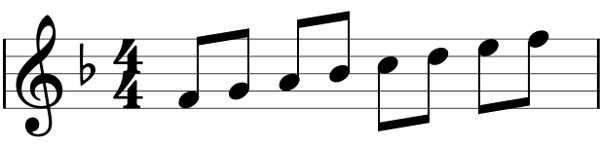
This key signature has i flat note on the middle line, which represents the note B. This key signature is telling us to play B-apartment instead of B from now on.
All of the other notes stay the aforementioned, but when we get to what looks like B, we need to retrieve to play B flat.
Fundamental signatures aren't always used. Sometimes the person writing the sheet music will employ sharps and flats throughout the slice, while other people volition use key signatures.
A key signature tin modify at any time, so lookout man for new signatures.
There is a key signature for every major scale. Then the above key signature with one apartment is the cardinal signature for the scale F Major. The earlier fundamental signature with five sharps is the key signature for B Major.
The circle of fifths is a really useful resource to understand key signatures and major scales. I'm currently writing a guide on the circumvolve of fifths, and then subscribe to updates here to be notified when it is bachelor.
How to Read Tempo
The vocal'southward tempo is ordinarily indicated at the start of any canvas music as shown below:
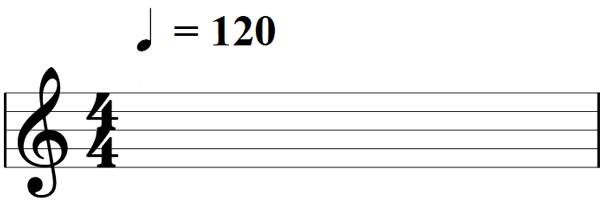
This number tells united states of america the beats per minute of the song. And then if the tempo shows threescore, that means 60 beats per minute (a beat every 2nd). If the tempo is 120 bpm, that means two beats per 2d.
If you want to observe out how fast any tempo is, all you demand is a simple metronome.
Yous could purchase a physical metronome, simply there are plenty of free metronome apps you can apply that practice the aforementioned job.
The tempo of a song can change, then keep an eye out for tempo symbols throughout the sheet music.
How to Read Music Symbols
Similar to how Guitar TAB uses unlike symbols to point different techniques (detect out most Guitar TAB symbols here), standard notation also uses symbols.
If you already know how to read the symbols used in Guitar TAB, y'all will find many of the symbols used in standard notation easier to read.
Hither are the most common symbols you are likely to run across and what they mean.
Curved Lines
A curved line tin can mean two unlike things. If a curved line connects ii notes together of the same pitch, it is chosen a tie:
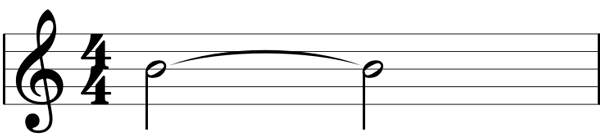
A necktie is telling united states that the 2d note is a continuation of the showtime annotation. In other words, you proceed property that first note and don't option it again.
Ties can connect notes together in the same bar and they can besides carried over to the next bar equally shown below:

In the above case, the concluding note in the bar continues to ring out for two beats in the second bar.
To piece of work out the total length of a note, you add up the lengths of all of the notes nether the necktie (more than two notes tin can exist tied together).
If a curved line connects dissimilar notes together (ii or more), this is the symbol forlegato.
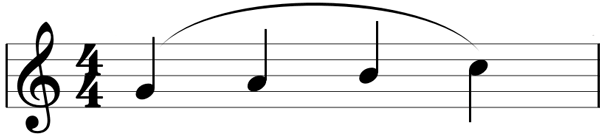
Legato is when you pick the first annotation, simply don't pick the next notes. Hammer-ons, pull-offs, slides, and tapping are all forms of legato.
Sometimes sheet music volition employ H or S forth with a curved line to tell yous to play hammer-ons or pull-offs as shown below:

In the above example, yous pick the note G, then hammer-on to A. So you choice the annotation B and hammer-on to C.
If you lot see a sloped line connecting the notes as well as a curved line equally shown below, that's telling you to play a slide.
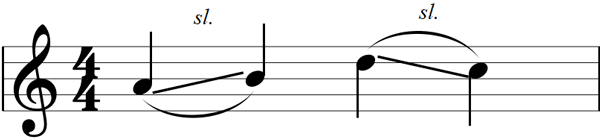
The letters sl. may also announced to point slides.
Repeat Signs
When a part of a song is repeated over and over (eg: a riff that keeps repeating throughout the vocal), instead of writing the bar over and over, arepeat sign can be used.
In that location are 2 parts of a repeat sign: the starting time and the end as shown below:
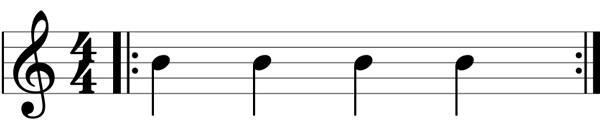
The double vertical lines and the two dots are used at the get-go and cease of the department that is to be repeated.
The above instance is telling u.s.a. to play the four notes, and so play the four notes again before moving on to the next bar.
A single bar can be repeated or a long section can be repeated. The dots are always on the within of the bar lines of the section to be repeated.
If a bar is to be repeated more than twice, information technology will tell yous with a number to a higher place the cease repeat sign every bit shown below:
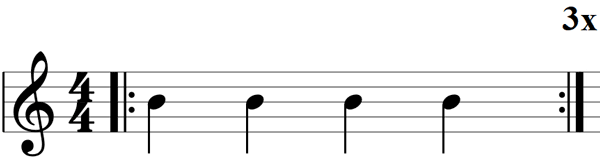
This example is telling u.s.a. to repeat the bar three times before continuing.
Alternate Endings
Quite often, something will repeat a few times, then on the last repetition, there will be a slight change.
Instead of having to write the entire section out, nosotros can usealternating endings to repeat everything except the concluding bar.

What the in a higher place example means is that the first three times, you repeat the outset two bars. Then on the fourth time, you play the first bar, then you lot skip alee and play the tertiary bar.
The numbers tell you what to play on each repetition. That'south why we play the third bar (labeled with 4) on the fourth repetition and skip the second bar (labeled with 1-3).
Alternate endings may seem confusing at first, but they brand canvass music much easier to read as y'all can seriously cut down on how many pages information technology takes to write out a vocal.
Shuffle Feel
Some music doesn't have what is known every bit a 'straight experience'. In music such as blues, it might have a 'shuffle feel'.
Instead of re-writing sail music to match the rhythm of something with a shuffle feel, we can write the music every bit normal and add ashuffle feel symbol every bit shown below:
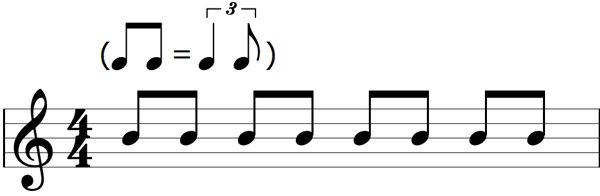
What this ways is that instead of playing 8th notes as normal (eg: i and 2 and iii and 4 and), you play them with a shuffle experience (eg: ane and2 and3 and4).
While the above notes expect evenly spaced, they're played with a shuffle.
There are dissimilar types of shuffles you could use, but the in a higher place example with eighth notes is the nigh common.
Finger Numbers
While it is uncommon, you might be lucky and sheet music may include some suggestions on what fingers to use.
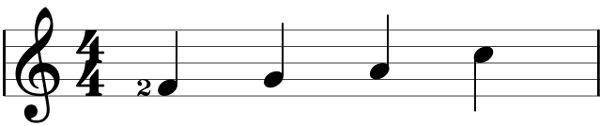
In the higher up case, the number next to the first notation is a recommendation on which finger to utilize.
Index finger is ane, centre finger is 2, band finger is 3, and pinky is four.
Sometimes well-nigh of the notes will be given numbers, merely information technology's more than common to run across the first number of a office with a number. And then you need to figure out the other fingers on your ain.
Normally in one case you know which finger to start with, it's pretty easy to effigy out the residuum.
String Numbers
A limitation of standard notation is that the notes on the staff don't tell you where to play them on the fretboard.
For example, an E in the acme infinite on the staff could be played on six different positions (if y'all take a 24 fret guitar).
It's rare, but you might exist lucky and sheet music will tell you which string a note is to be played on using a number in a circle.
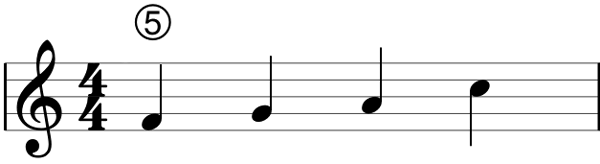
In the to a higher place example, the first note is to be played on the fifth string.
Usually, simply one or two notes will accept this notation and yous have to effigy out the rest.
In that location are plenty of other symbols used in standard notation, just the to a higher place examples should give you enough to go started and showtime reading music.
As near sail music available today provides a combination of standard annotation and Guitar TAB, you may detect learning both methods helpful.
Bank check out this Guide to Acquire How to Read Guitar TAB. Many of the symbols used in standard notation also apply in Guitar TAB, so you might desire to check out the symbols department in the guide.
If you volition be learning songs that use a lot of chords, make sure you know how to read chord diagrams by reading this guide.
Related Guides and Lessons:
Source: https://guitargearfinder.com/guides/read-standard-notation/
0 Response to "How to Read Music on Treble Strings"
Post a Comment